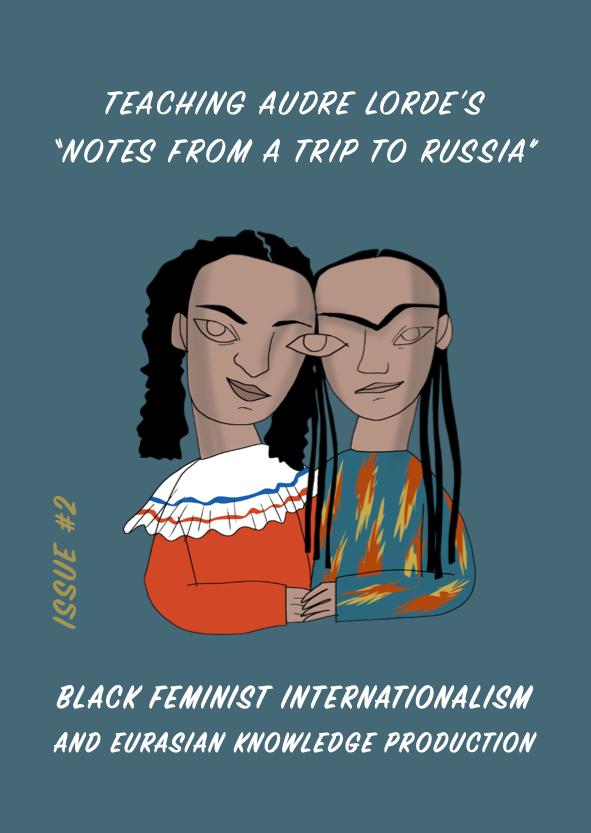
I am happy to introduce the Gazette#2 “TEACHING AUDRE LORDE’S
“NOTES FROM A TRIP TO RUSSIA”.
The Gazette can be accessed here (https://publuu.com/flip-book/361412/2293999)
This issue of The Archive Revisited turns to an often-overlooked text within Audre Lorde’s body of work — her 1976 essay “Notes from a Trip to Russia.” Though it opens Sister Outsider (1984), the essay rarely appears in feminist syllabi or discussions of Lorde’s global legacy. Yet, as contributors to this issue remind us, “Notes” is a vital record of transnational encounter: a text where Black feminist thought meets the layered histories of Soviet modernity, Central Asian colonialism, and the emotional and political complexities of cross-cultural solidarity.
Our collective aim in this gazette is to ask what it means to teach this essay now. What happens when we place Lorde’s reflections on the Soviet Union in dialogue with our current moment— marked by resurging authoritarianism, racialized nationalism, and the unfinished work of decolonization? How might this text, written nearly fifty years ago, help us reimagine feminist pedagogy across languages, geographies, and political divides?
Bringing together scholars, teachers, and artists from the U.S., Central Asia, and Europe, this issue foregrounds teaching as a critical practice of translation and relation. The essays, teaching artifacts, and conversations gathered here approach Lorde’s travel notes not as a closed document of Cold War history, but as a living pedagogical archive—one that continues to generate curiosity, discomfort, and transformative learning. In revisiting Lorde’s journey through Soviet Eurasia, we invite readers to reflect on the forms of listening, vulnerability, and imaginative inquiry that teaching across borders requires.
By attending to the silences and contradictions within “Notes from a Trip to Russia”—the moments of recognition and misrecognition, solidarity and estrangement—our contributors reveal the essay’s ongoing relevance to global feminist thought. To teach Lorde’s “Notes” today is to teach with uncertainty, with openness, and with the conviction that the work of building transnational understanding remains unfinished.
 The Archive Revisited