What do we do with the parts of history that were never written down?
The encounters that left no diary entries. The solidarities that passed quietly between people. The knowledge carried through touch, gesture, desire, or memory—rather than official record.
These moments are not marginal. They make up much of what I encounter when tracing connections between Black feminist Internationalism and the Eurasian borderlands. While the archive of Black feminist Internationalism is not small, its traces in Soviet Eurasia are scattered, fragmented, and often missing altogether. This absence is striking, especially given how influential the region was for many Black Internationalists.
That gap raised a question of method for me: how do we work with histories shaped by erasure—by Cold War politics, racial and sexual norms, state surveillance, and personal decisions about what could safely be recorded? What kind of approach can do justice to stories that were never meant to survive on paper?
Across Indigenous, Black feminist, queer, and decolonial traditions, knowledge is not defined by how neatly it fits into an archive box. It lives in relationships, in shared struggle, in moments of care and risk. These traditions taught me to approach the archive not as a final authority, but as one doorway among many in aspiration to “unlearn imperialism/s.”
This matters in very practical ways. Take Audre Lorde’s 1976 visit to Soviet Eurasia. In the official record, her trip appears carefully managed—lectures, translations, scripted encounters. But in her writing, a different kind of moment flickers into view: an intimate, erotic connection with an Indigenous woman from Chukotka in Tashkent. The encounter is brief. The details are spare. There is no name, no sustained narrative, no archival trail to follow on the other side.
From the standpoint of conventional history, this moment barely counts. It cannot be corroborated. It produces no documentation beyond Lorde’s own reflections. And yet, it tells us something crucial about how solidarity was lived—not as policy or ideology, but as feeling, desire, curiosity, and risk. It reveals a form of connection that could not be officially sanctioned and therefore could not be fully archived.
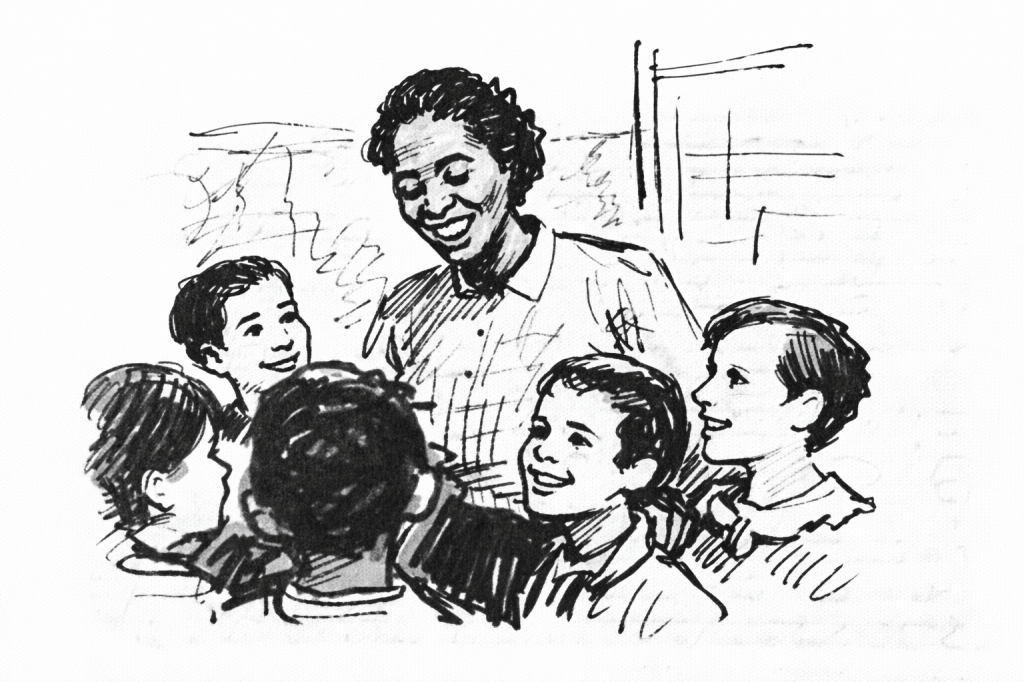
Pic.1. Speculative sketch, “Thyra Edwards with Soviet children in 1934,” 2025. All sketches in this series, Black-Eurasian Encounters, are imaginative reconstructions created by the author with AI assistance and are not based on historical photographs of the depicted scenes.
My work begins from this kind of fragment. Not with the question Can I prove this happened? but Why does this trace matter now? What does it reveal about how people reached for one another across empire, across difference, across constraint?
Rather than treating silence as a dead end, I see it as an opening. When we read archives not only for what they contain, but also for what they leave out—or actively suppress—a richer landscape comes into view. Voices do not return because we force them to speak, but because we learn how to listen differently: to context, to emotion, to what could not safely be said.
This way of reading invites us to imagine histories beyond the limits set by colonial and imperial ways of knowing. It allows us to sense the fullness of past worlds that exceeded the record. And it reminds us that the past is not closed. It is unfinished—still reaching toward us, offering lessons, tools, and intimacies that shape how we understand the present and imagine possible futures.
When we read with, against, and beyond archival silences, we don’t lose rigor. We gain perspective. The archive becomes less a ledger of completed facts and more a living companion—guiding us toward the stories that continue to matter, even when they survive only in fragments.
1. History Isn’t Just About Facts—It’s About Power
We often think of history as a collection of facts waiting to be discovered. If we just look hard enough in the archive, the story will reveal itself. But archives are not neutral spaces. They are built by states, empires, and institutions. They reflect what those systems chose to preserve—and what they were willing to let disappear.
Much of my work begins with this recognition:
- Absence in the archive is not absence in history.
- Silence is itself a political outcome.
When I began researching Black feminist Internationalism in Soviet Eurasia, this became impossible to ignore. The connections were clearly there, yet the record was thin, scattered, and uneven. Travel appears in fragments. Relationships surface briefly, then vanish. Entire encounters seem to have slipped through the cracks.
This is where a decolonial method begins—not by asking what’s missing as a problem to solve, but by asking why it’s missing.
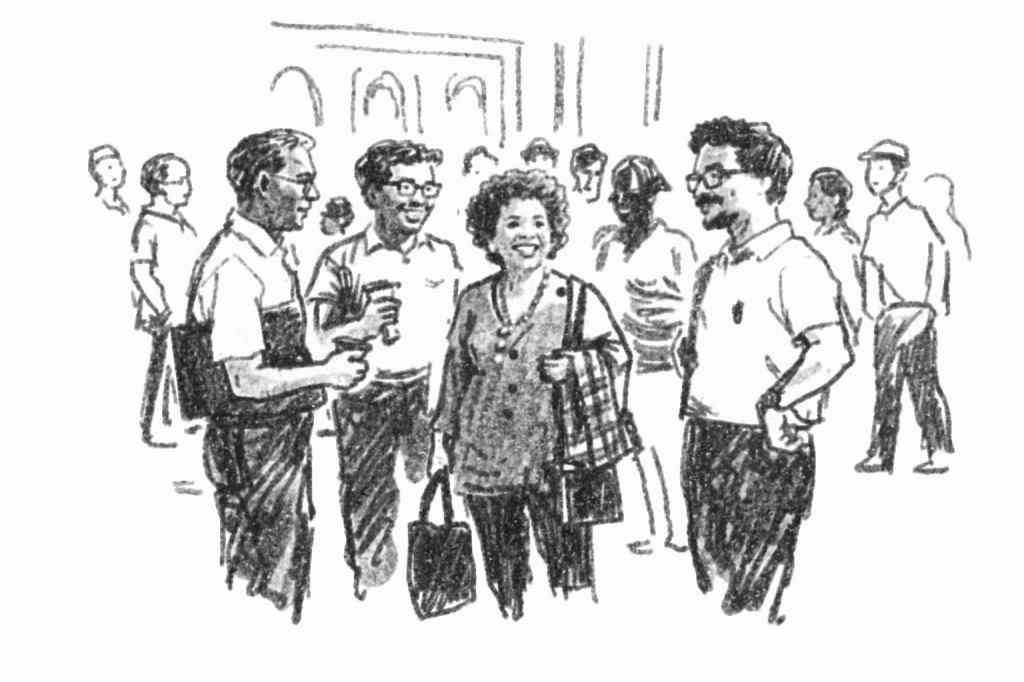
In my research, Black women’s journeys to the Soviet Union are often documented through official visits, speeches, or state-approved exchanges. But the everyday encounters—the conversations on trains, moments of care, intimacy, or conflict—rarely make it into the archive. Like with Audre Lorde’s visit which official records frame as cultural diplomacy. Yet in her own writing, a fleeting but meaningful erotic encounter with an Indigenous woman appears almost in passing. There is no name, no follow-up, no archival trail on the other side. And still, that moment tells us something the official record cannot: how solidarity was felt, not staged.
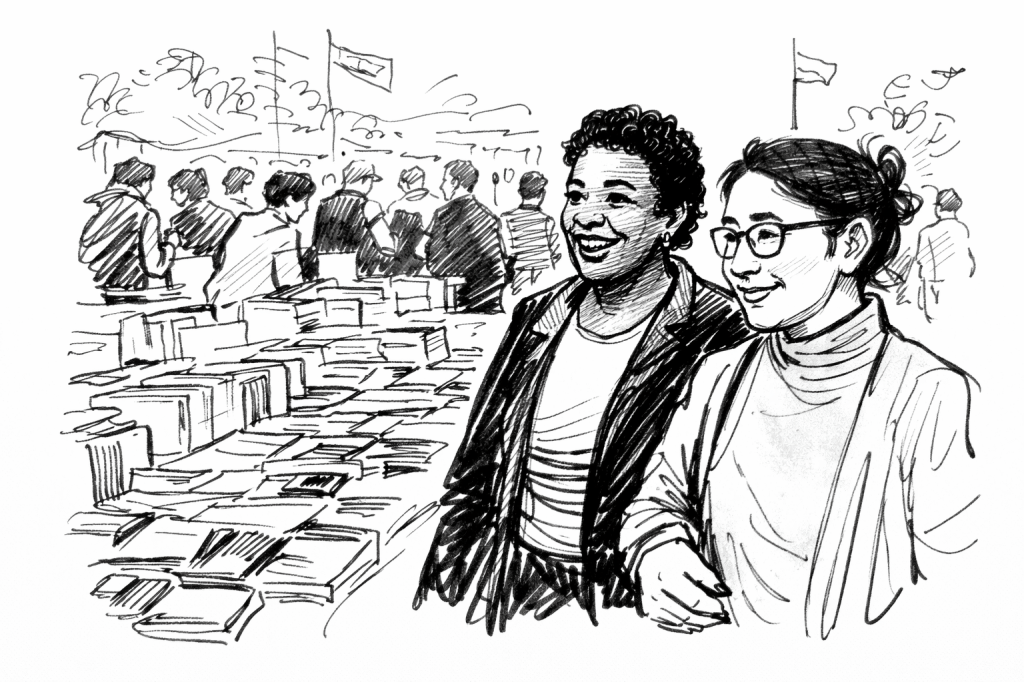
Pic.2. Speculative sketch, “Audre Lorde and Antonina Kymytval’ at book affair in Tashkent in 1976,” 2025. All sketches in this series, Black-Eurasian Encounters, are imaginative reconstructions created by the author with AI assistance and are not based on historical photographs of the depicted scenes.
From this perspective, absence is not the same as nonexistence. Silence is not empty. It is often the result of power—of surveillance, censorship, fear, and unequal access to preservation.
This is why I treat gaps in the archive not as failures of evidence, but as clues. They point to the conditions under which people lived, moved, and connected—and to the forces that made some lives legible and others disposable. Reading this way doesn’t mean abandoning rigor. It means expanding what we count as historical knowledge and taking seriously the lives and relations that were never meant to be archived in the first place.
2. Storytelling Is Part of the Method
A decolonial approach doesn’t separate storytelling from analysis. For me, they are inseparable.
My research draws on Indigenous, Black feminist, queer, and Eurasian ways of knowing—i.e. traditions that have long existed alongside, and often in tension with, Western academic models. In these traditions, knowledge isn’t only produced through documents or linear timelines. It lives in relationships, in bodies, in memory, and in the ways, people make sense of the world together.
This is why I don’t approach history as a puzzle to be neatly assembled. Instead of aiming for a complete or perfectly ordered account, I pay attention to moments that feel charged—emotionally, politically, or relationally—even when they appear only briefly in the record.
For example, in the archive of Black women’s travel to Soviet Eurasia, official materials often emphasize speeches, meetings, and ideological alignment. But what stayed with me were smaller, less legible moments: e.g., a night spent stranded at a train station in Tbilisi, where Hermina Dumont Huiswoud exchanged stories with a local woman, which never appears in any official account.
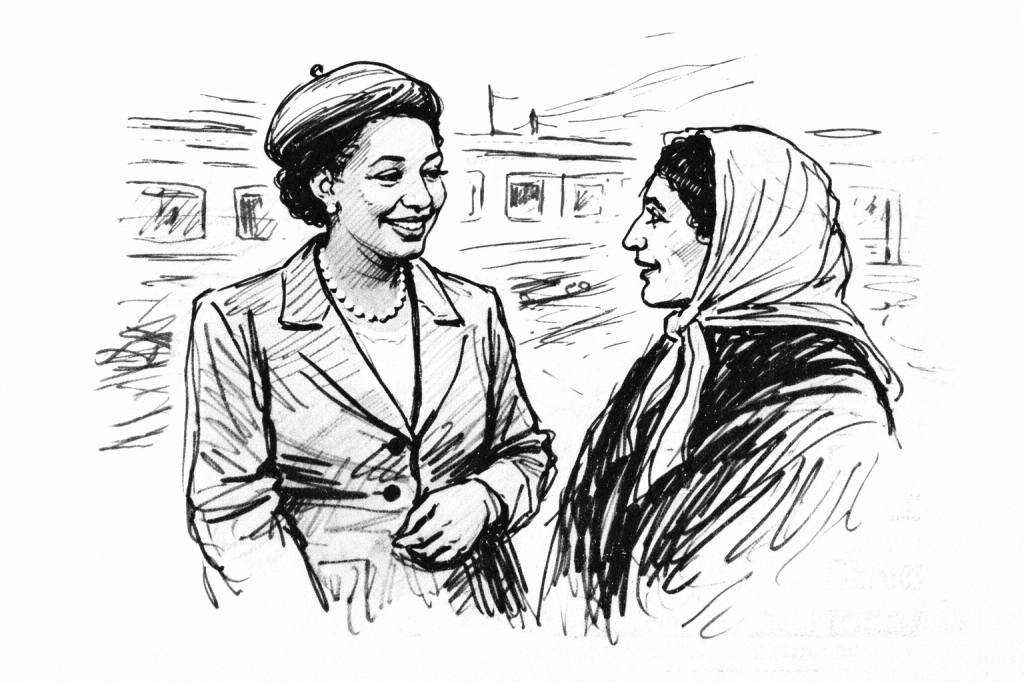
Pic.3. Speculative sketch, “Hermina Dumont Husiwoud: Conversation at Tbilisi train station in 1932,” 2025. All sketches in this series, Black-Eurasian Encounters, are imaginative reconstructions created by the author with AI assistance and are not based on historical photographs of the depicted scenes.
Such moments “prove” anything in the traditional historical sense. But they reveal how people navigated empire in everyday ways—through curiosity, desire, discomfort, and care. They show how solidarity often formed not through formal alliances, but through unscripted encounters that could not be planned or preserved.
So rather than asking, Can I document this beyond doubt? I ask a different question: What does this moment help us understand about power, intimacy, survival, or connection? That shift moves research away from verification alone and toward meaning making. It allows history to be read not just as a record of events, but as a space where imagination, feeling, and lived experience matter.
3. Reading With—and Against—the Archive
A decolonial method asks us to read the archive in two directions at once.
I draw inspiration from approaches like Saidiya Hartman’s critical fabulation, Avery Gordon’s haunting, and Ariella Aisha Azoulay’s potential history, which invite us to work with archival material while also pushing against its limits. That means taking documents seriously—but refusing to let them set the boundaries of what counts as truth.
In practice, this kind of reading is fairly simple. I look at what’s there. I pay close attention to what isn’t. And I ask why.
In my research, some Black women’s journeys to Soviet Eurasia appear only in fragments—a few postcards, a passing mention in someone else’s papers, a line in a travel essay. Take Williana Burroughs, whose political work and travels were significant, yet whose time in Soviet Union survives only in scattered traces, in someone’s else collection. The scarcity of material is not just frustrating; it’s revealing. It raises questions about surveillance, censorship, and whose movements were considered worth recording.
Rather than treating these gaps as dead ends, I treat them as part of the story. What kinds of political pressures shaped what could be written down? What risks did Black women face as communists, travelers, or queer subjects? What kinds of relationships or solidarities might never have been safe to document at all?
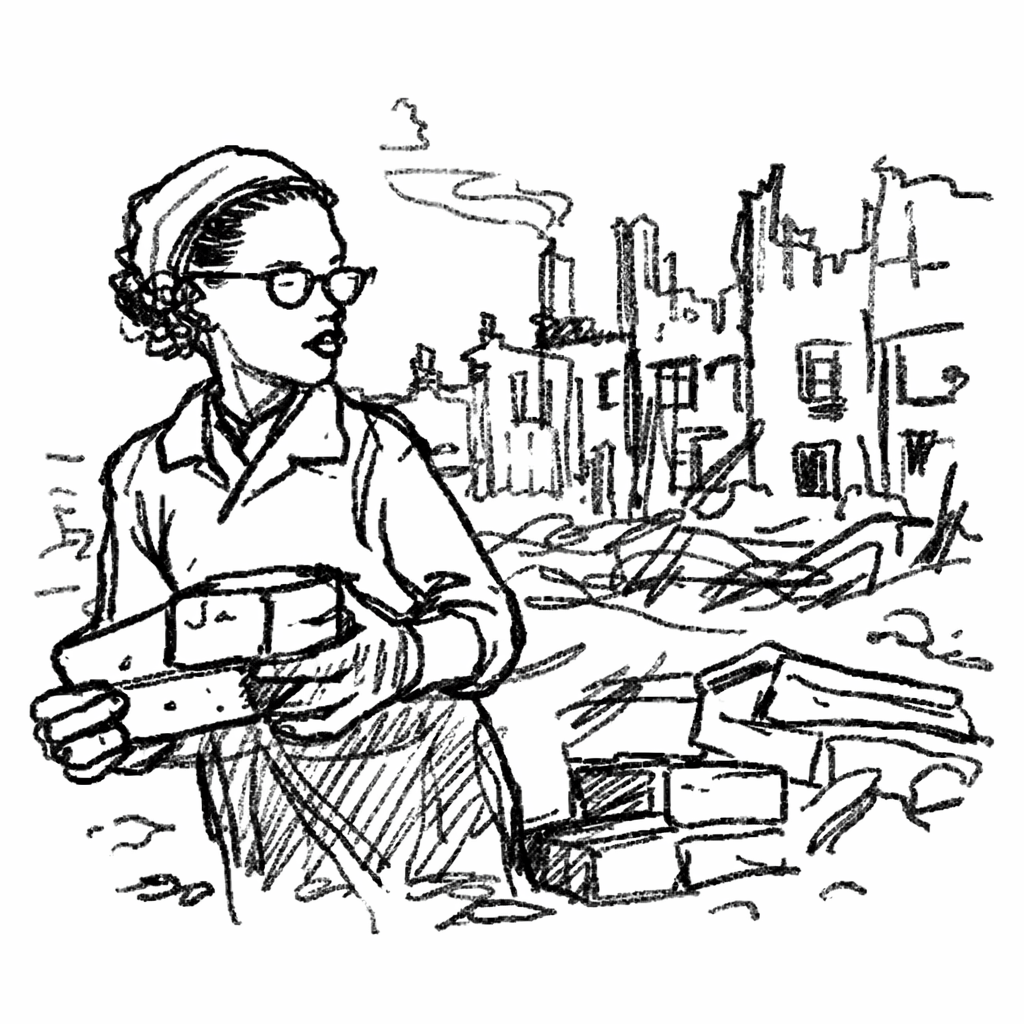
Pic.4. Speculative sketch, “Esther Cooper Jackson: Restoring Stalingrad in 1946,” 2025. All sketches in this series, Black-Eurasian Encounters, are imaginative reconstructions created by the author with AI assistance and are not based on historical photographs of the depicted scenes.
This is not about inventing lives or filling in blanks for the sake of narrative. It’s about refusing to let imperial record-keeping define the limits of historical imagination. In this approach, context becomes a form of evidence. Geopolitical conditions, Cold War paranoia, the emotional tone of a letter, or the sudden disappearance of a voice from the record can tell us as much as an official report.
Reading this way doesn’t replace the archive. It expands it. It allows us to sense histories that were lived but never fully captured—and to take seriously the lives and connections that imperial systems worked hard to make forgettable.
4. Not Closing the Past, but Asking Why It Still Haunts Us
Most historical writing aims for closure. The goal is to explain what happened, put it in order, and move on.
My work takes a different approach. Instead of asking how to finish the story, I ask why certain moments refuse to disappear.
Some encounters linger long after the conditions that produced them are gone. Others are actively forgotten, dismissed as naïve, compromised, or irrelevant. That uneven afterlife is not accidental. It tells us something about how power continues to work in the present.
One example that keeps returning in my research is the global response to Angela Davis’s imprisonment in the early 1970s. Across Soviet Eurasia, people who had never met her organized rallies, wrote letters, and spoke her name with a sense of intimacy and urgency. Today, that history is often reduced to Cold War spectacle or propaganda. What gets lost in that dismissal is the emotional and political force of the connection itself—the idea that struggles against racism and imprisonment in the United States could feel personal to people living thousands of miles away (see also similar conversations in articles by Sandra Joy Russell and Jamele Watkins). Such an approach can also lead to a more nuanced critique of what was at stake in ways that disrupted genuine connection, exemplified, for example, by the work of Tereza Hendl and Selbi Durdiyeva.
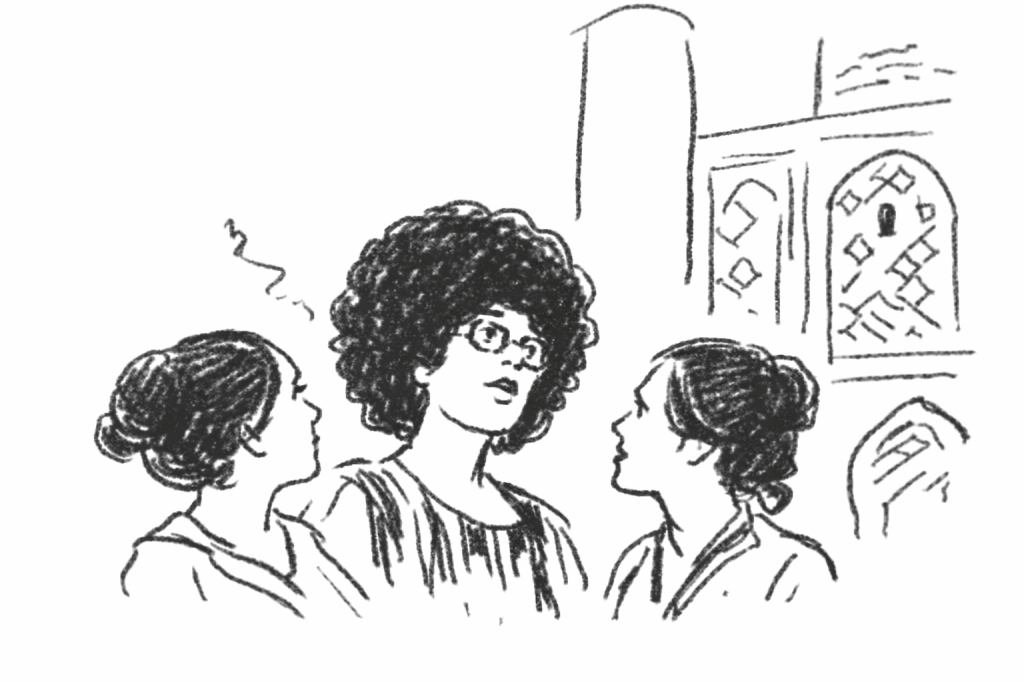
Pic.5. Speculative sketch, “Angela Davis in Samarkand in 1972,” 2025. All sketches in this series, Black-Eurasian Encounters, are imaginative reconstructions created by the author with AI assistance and are not based on historical photographs of the depicted scenes.
So, I ask: why has this solidarity been so easy to write off? What kinds of political work does that erasure perform now? Whose visions of connection become impossible if we treat these histories as embarrassing detours rather than serious attempts to imagine another world?
From a decolonial perspective, the past is not something we simply inherit or correct. It is something that keeps pressing on the present. Unresolved tensions—around empire, race, gender, and freedom—continue to shape how we think, organize, and imagine what is possible.
Reading history this way doesn’t offer neat answers. It keeps questions open. It treats the past as unfinished enterprise—a terrain of struggle whose afterlives still matter, not because they were perfect, but because they remind us that other ways of relating across borders once felt possible and might again.
5. Interdisciplinarity as a Politics, not a Technique
Pic.6. Speculative sketch, “Group scene with Alice Childress in Tashkent in 1971,” 2025. All sketches in this series, Black-Eurasian Encounters, are imaginative reconstructions created by the author with AI assistance and are not based on historical photographs of the depicted scenes.
Interdisciplinarity is often described as a technical skill—mixing methods, borrowing theories, or moving between fields. For me, it’s something else entirely. It’s a political choice.
The histories I work with don’t sit comfortably inside a single discipline. Imperial violence doesn’t belong to history alone. Intimacy doesn’t fit neatly into political theory. And the lived connections between Black, Indigenous, and Eurasian communities can’t be fully understood through any one archive or method.
This became clear as I moved through materials that refused categorization. A travel essay reads like literature, but it’s also political testimony. A letter carries historical detail, emotional weight, and the trace of surveillance. An intimate encounter—like the one Audre Lorde describes in Tashkent—opens questions about sexuality, empire, race, and power that no single field can hold on its own.
Approaching this work interdisciplinarily allows staying with that complexity rather than flatten it. Movement between history, Black studies, Indigenous studies, gender and queer theory, literary analysis, and political thought thus aims not to build a “hybrid method,” but to avoid the boundaries that have long made certain people, places, and relations disappear.
Those boundaries matter. They are not neutral. Disciplinary lines have often mirrored imperial ones, deciding which regions count as central, which struggles are comparable, and which forms of knowledge are credible. Refusing those limits is part of the work.
Seen this way, interdisciplinarity isn’t about doing more. It’s about listening differently. It’s a way of staying accountable to stories that don’t behave, don’t line up, and don’t resolve—stories that ask us to think across borders, archives, and inherited ways of knowing.
6. Why This Matters—even if You Trust “Evidence-Based Research”
Evidence doesn’t appear on its own. It’s shaped by who had the power to record, whose words were taken seriously, and what political conditions made documentation possible—or dangerous. Every archive reflects those choices, whether or not they’re acknowledged.
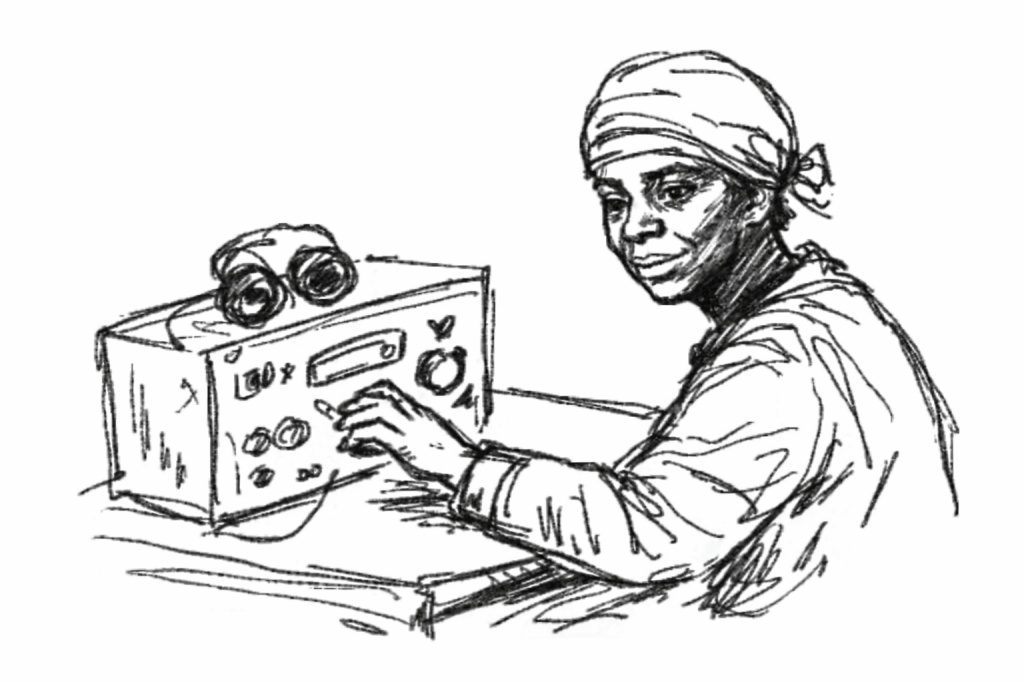
Pic.7. Speculative sketch, “Williana Burroughs at the radio controls during 1934-1945,” 2025. All sketches in this series, Black-Eurasian Encounters, are imaginative reconstructions created by the author with AI assistance and are not based on historical photographs of the depicted scenes.
In my research, this becomes visible again and again. Black women traveling through Soviet Eurasia often appear in the record only through official channels—conference programs, state photographs, carefully worded reports. But the moments that shaped their experiences most deeply rarely show up there: the conversations that happened off-script, the relationships formed in private, the ways surveillance shaped what could safely be written down.
Take the case of postcards sent from Central Asia. A few short lines, cheerful on the surface, reveal very little at first glance. But read alongside what we know about censorship, postal monitoring, and racialized scrutiny of foreign travelers, those silences begin to speak. What isn’t said becomes as important as what is. The postcard doesn’t stop being evidence—it becomes a different kind of evidence.
I’m not rejecting documentation or rigor. I’m asking what else we might need to take seriously if we want to understand lives shaped by empire. Feminist and decolonial scholars have long argued that evidence can take many forms: a gesture, a pause, a rumor, a missing file, a fleeting encounter between marginalized women, or the emotional charge of a moment that left no official trace.
These are not inventions. They are the everyday archives of people whose lives were never meant to be fully recorded. Expanding what we recognize as evidence doesn’t weaken research. It makes it more honest about the conditions under which knowledge is produced—and about whose histories we’ve been trained not to see.
7. Solidarity Across Silence
At the heart of my method is a simple question: how did people build anti-imperialist connections across borders—even when surveillance, censorship, racism, and geopolitics worked against them?
To follow those connections, I have to work with what remains. Fragments. Glimpses. Brief moments of contact that were never meant to last on the page. These traces don’t add up to a clean story, and I don’t try to make them do so.
Instead, I follow them because of what they reveal.
In my research, solidarity often appears in small, unspectacular ways: a shared meal after an official meeting ends; a whispered conversation on a train platform; a fleeting intimacy, like the one Audre Lorde describes in Tashkent, that carried political meaning even if it left no archival trail. These moments rarely survive in state records, but they mattered deeply to the people who lived them.
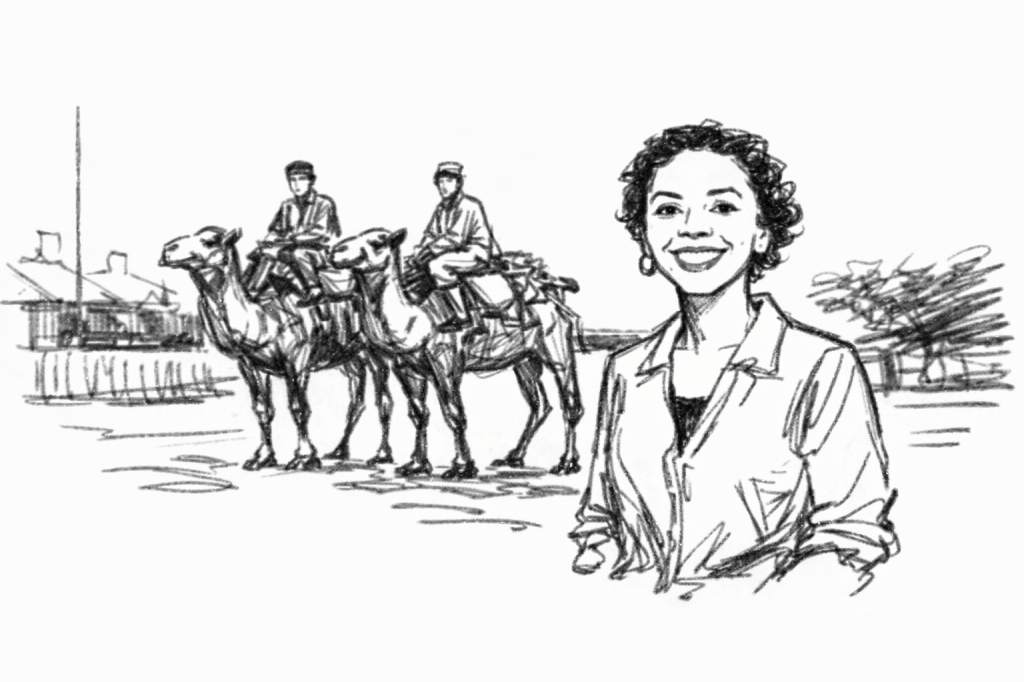
Pic.8. Speculative sketch, “Louise Thompson Patterson enroute to Uzbekistan in 1932,” 2025. All sketches in this series, Black-Eurasian Encounters, are imaginative reconstructions created by the author with AI assistance and are not based on historical photographs of the depicted scenes.
What emerges from these fragments is not a polished narrative of internationalism, but something more fragile and more powerful. They show how people reached for one another across difference—across language, race, sexuality, and geography—often in ways that were risky, improvised, and deliberately undocumented.
I don’t reconstruct these moments to complete the past. I stay with them because they point to what empire has always tried to contain: the possibility that people might recognize themselves in one another, even under conditions designed to keep them apart.
Reading for solidarity across silence doesn’t promise certainty. It offers something else—a way of paying attention to histories of connection that were never meant to endure, but that still shape how we understand resistance, intimacy, and the futures we can imagine together.
8. Land and Place Are Part of the Method
A decolonial method is also a spatial one. It asks us to pay attention not only to what is recorded, but where histories unfold—and under what imperial conditions.
Land and place are often treated as background in historical writing: neutral settings where events simply happen. But empires organize space very carefully. Borders are drawn and enforced. Routes are opened or closed. Some places become visible as symbols of progress or international friendship, while others absorb violence and disappear into the background. These spatial decisions shape the archive just as much as censorship or state policy.

Pic.9. Speculative sketch, “Claudia Jones by the Crimean Shore in 1962,” 2025. All sketches in this series, Black-Eurasian Encounters, are imaginative reconstructions created by the author with AI assistance and are not based on historical photographs of the depicted scenes.
The histories I trace unfold on contested land and across imperial geographies that were never neutral. When Black women traveled through Soviet Eurasia, they moved through spaces shaped by settler colonialism, Indigenous dispossession, and tightly managed mobility. Where they were taken, what they were shown, and which encounters could be documented were all shaped by how the state organized territory and labor.
Take, for example, Audre Lorde’s time in Tashkent. This was not just any city. It was a carefully curated Soviet site of “Third World” internationalism, built on Central Asian land shaped by Russian imperial rule and ongoing Indigenous marginalization. Lorde’s fleeting, undocumented encounter with an Indigenous woman from Chukotka did not happen in abstraction—it happened within this layered imperial space, one that shaped what could be seen, said, desired, and remembered. The absence of an archival trace is inseparable from the politics of place.
One more telling example appears in the visual record. Many visitors to Central Asia posed for photographs in cotton fields—images meant to symbolize socialist abundance, racial equality, and shared labor. Read only at the level of representation, these photographs seem to affirm solidarity. But the land itself tells another story. Cotton production in the region relied on coercive labor, environmental devastation, and the long afterlives of colonial extraction. The smiling images obscure the violence embedded in the landscape, making solidarity uneasy even before we turn to written archives.
This tension matters. It shows how imperial space can produce images of connection that rest on unspoken forms of exploitation. Even when evidence survives in visual form, land complicates what those images can mean.
Reading decolonially, for me, means staying attuned to how power works through space as much as through text. Solidarities don’t emerge in the abstract. They take shape in specific locations—on trains, in border cities, on collective farms, in state-managed cultural hubs, in places where people crossed paths despite surveillance and constraint. Attending to land and place allows us to see how imperial geographies structure both connection and erasure, and why some histories survive while others remain only as fragments.
Reimagining the archive beyond evidence and proof therefore also requires rethinking land itself: not as a backdrop to history, but as an active force that shapes what can be seen, remembered, and ethically held together.
Why this Method Might Feel Unfamiliar—and Why That’s the Point
If you’re used to thinking of “evidence” as official documents, statistics, or state records, this approach may feel strange at first. It can look speculative, even risky. But much of the world—especially Black, Indigenous, queer, and colonized life—has never fit neatly into the kinds of archives Western institutions were built to preserve.
That’s not an accident. It’s a feature of how power works.
The method I’m describing grows out of that recognition. It starts from the assumption that lives lived under empire, surveillance, and racialized violence often leave traces that are partial, fragile, or deliberately obscured. Rather than treating those limits as a failure, I take them seriously as historical conditions in their own right.
My positionality matters here. I don’t come to the archive as a neutral observer, because neutrality has never been an option in these histories. I read as someone from Europe’s East, or Eurasian borderland, shaped by feminist, decolonial, and anti-imperialist traditions that taught me to notice who gets to speak, who gets believed, and whose experiences are routinely dismissed as anecdotal, emotional, or unprovable. That location shapes the questions I ask, the silences I linger with, and the kinds of connections I’m willing to take seriously.
This way of working insists that fragments, feelings, intimacies, and fleeting encounters are not outside history. They are part of how history is lived. And attending to them opens up different ways of thinking about solidarity—ones that aren’t limited to formal alliances or official recognition, but rooted in care, risk, and mutual recognition across distance and difference.
Why does this matter now? Because we’re living through another moment of war, extraction, and resurgent empire, where certain lives are again treated as disposable and certain forms of connection are dismissed as naïve or impossible. Reading the past only for what can be proven beyond doubt can quietly reinforce those same logics.
This method offers something else. Not certainty, but responsibility. Not closure, but attention.
History, from this perspective, isn’t a finished account waiting to be verified. It’s an invitation—to read more carefully, to listen for what didn’t survive intact, and to stay accountable to the lives and relations that were never meant to endure on paper.
That, for me, is what it means to reimagine the archive beyond evidence and proof: not abandoning rigor but practicing a form of care that keeps the past open enough to help us imagine freer futures.
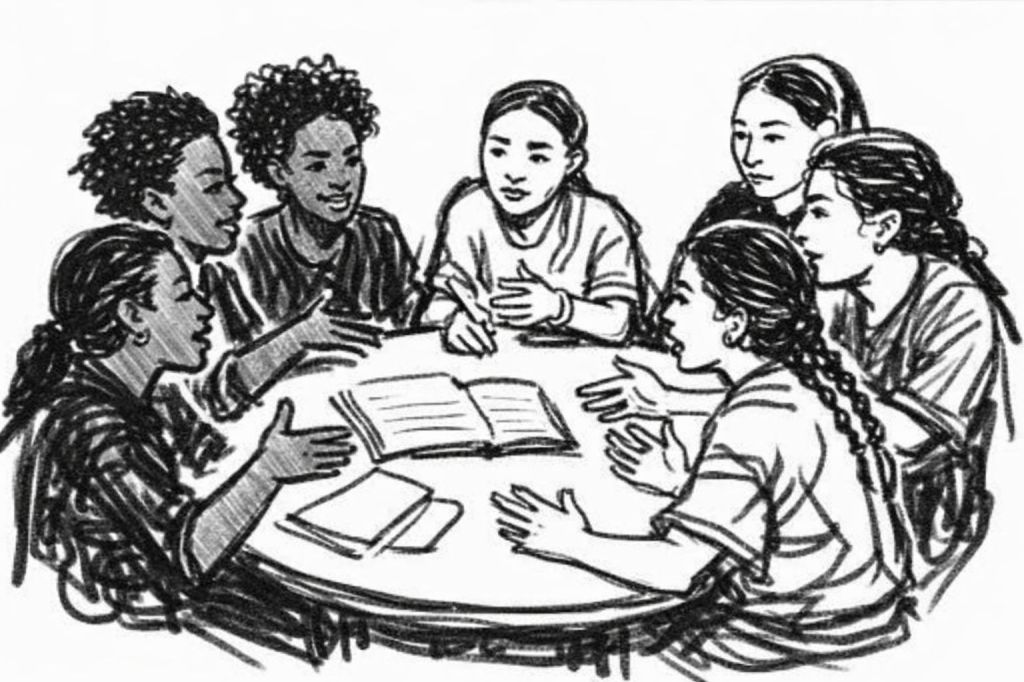
Pic.10. Speculative sketch, ““Black-Eurasian Roundtable,” 2025. All sketches in this series, Black-Eurasian Encounters, are imaginative reconstructions created by the author with AI assistance and are not based on historical photographs of the depicted scenes.
 The Archive Revisited