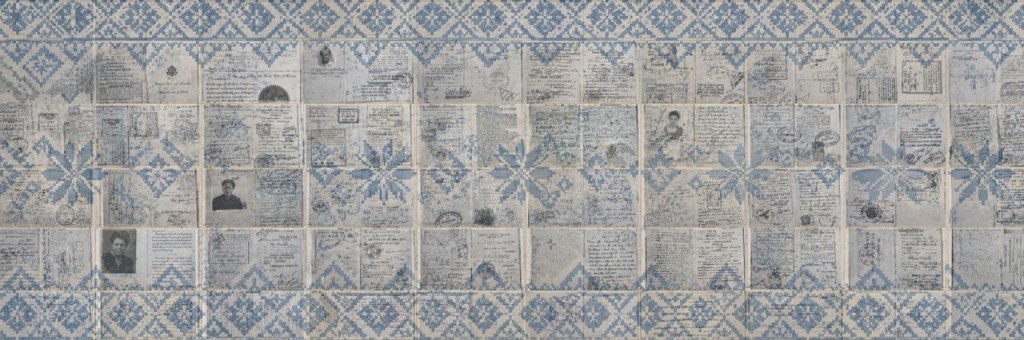
Collage created by the author using archival documents and Canva, 2026.
Some archival artifacts that initially seem unrelated to a project may stay with you long after you leave the reading room. For me, the first was a postcard depicting a veiled figure in Soviet Central Asia, preserved among Hermina Dumont Huiswoud’s papers. It did not fit my immediate research project, yet it kept haunting me.
What did this fragile trace, this gesture of preserving someone’s photograph, mean? I could not know why Huiswoud had kept it, or what connections she might have imagined through it. But the postcard taught me to attend to what an archive cannot fully reveal: encounters that never happened, solidarities imagined across distance, and desires that survive in fragments rather than complete narratives. It invited me to see archival objects not simply as evidence to be decoded, but as provocations to think beyond what can be known. Such an approach resonates with scholarship that treats archives as sites shaped by power and attends to the silences, uncertainties, and absences that historical documents cannot resolve.
Perhaps this is why another set of archival materials has recently begun to haunt me: passports and the documents surrounding them. I photographed these materials almost instinctively, just in case, without fully understanding why they had caught my attention. Now I find myself returning to them with a different kind of urgency. Like the fractured postcard, these documents tell only part of a story. They record permissions, borders, and official decisions, but also point toward lives shaped by movement and its interruption, by encounters made possible and others foreclosed. Looking at them now, I find it increasingly difficult to separate their histories from the present.
The immediate connection I see in the archive is with the lives of Black Internationalist women whose political commitments brought them into conflict with the U.S. state and whose movements across borders were shaped by Cold War politics. Eslanda Goode Robeson and her husband, Paul Robeson, had their passports revoked in 1950 or withheld in the context of anticommunist repression and regained their ability to travel in 1958 following a Supreme Court decision limiting the government’s authority to deny passports on the basis of political beliefs and associations (Kent v. Dulles, 1958). Claudia Jones, a Trinidad-born communist organizer who had lived in the United States since childhood, was imprisoned under the Smith Act and deported to Britain in December 1955. Hermina Dumont Huiswoud, a Black communist and internationalist, navigated the precarity of political belonging under anticommunist surveillance and repression. In 1950, while in the Netherlands, she was denied an unrestricted passport renewal; the U.S. Consulate issued her a restricted passport and pressured her to return to the United States. She did not receive an unrestricted passport until 1958.
These histories are related, but the mechanisms were not identical. The Robesons’ passport restrictions, Jones’s deportation, and Huiswoud’s political vulnerability involved different legal and administrative processes. Read together, they nevertheless make it possible to see the passport as more than a record of travel. It becomes a trace of state power: the power not only to permit or deny movement, but also to regulate belonging and make mobility conditional on political allegiance. The documents preserve bureaucratic traces of these histories, yet they also invite us to look beyond the paper itself: to consider the lives disrupted, the connections made difficult, and the unequal conditions under which international solidarity was pursued.
Looking at these archival materials, I cannot help thinking about Belarus today. In September 2023, a presidential decree ended the provision of passport issuance and renewal through Belarusian diplomatic missions abroad. Belarusians who need to renew their passports must generally return to Belarus to do so, even when they left the country to escape political persecution. For people living in exile, this creates a potentially dangerous choice: return to a country where they may face interrogation, detention, or prosecution, or remain abroad with documents that may expire and increasingly constrain their ability to travel and establish or maintain legal status in their countries of residence. Human rights experts characterized the policy as a deliberate attempt to punish exiles for their perceived political disloyalty.
The historical circumstances are different, and these experiences should not be collapsed into a single story of state repression. Yet the passports bring them into an unsettling conversation. In both contexts, documents that ostensibly certify identity and citizenship also reveal how states can use the conditions of mobility to discipline political dissent and make belonging precarious. The connection lies not in the equivalence of these histories, but in the question, they raise together: what happens when the very documents that establish one’s membership in a political community become instruments for controlling where—and whether—one can go?
For me, this resonance also raises broader questions about what self-determination or independence is supposed to deliver and how we might understand political repression across multiple imperialisms. Black Internationalists faced political persecution and anticommunist repression in the United States, while some found refuge or forms of solidarity in the Soviet Union. Yet the Soviet Union was also an imperial formation, and its expansion and rule produced unequal relations among nationalities, restricted forms of political self-determination, and contributed to displacement and migration under Russian and Soviet imperial power. These histories do not cancel one another out. Rather, they complicate any account that treats one political system as a straightforward refuge from the violence of another.
Living in the United States as a scholar from Belarus, I sometimes experience my own mobility as another iteration of these histories of displacement and constrained movement—one that feels increasingly less voluntary. Crossing borders, even those others traverse routinely, can become a source of anxiety and uncertainty. What is often described as freedom of movement is, in practice, profoundly unequally distributed. Citizenship, race, class, labor, and border regimes shape who can travel, who must justify their presence, and who is exposed to prolonged uncertainty. Taken together, these histories invite us to think about how imperial violence travels across political systems, producing resonances without making distinct experiences interchangeable.
Yet such connections are often obscured in discussions of Eurasian borderlands by Western-centered geopolitical frameworks that render the region peripheral to broader histories of imperial violence or position Soviet power as somehow less oppressive than its Western counterpart. The concept of “nesting orientalisms,” developed by Milica Bakić-Hayden to analyze hierarchical representations of East and West, offers one way to understand how distinctions between different parts of Europe are reproduced. Extending this framework to Belarus and the wider Eurasian region requires attention to the specific histories and hierarchies through which these places have been represented. For me, the task is not to choose between histories of Western and Russian or Soviet domination, or to establish a hierarchy of imperial violence. It is to think across them: to trace their entanglements and differences, and to ask how the struggle for freedom in one context might illuminate—but never erase—the conditions of domination in another.
Belarus became formally independent in 1991, but independence did not bring sustained democracy or freedom from imperial power. Its post-independence history has been shaped by authoritarian consolidation, growing dependence on Russia, and political and economic relationships that did not disappear with the dissolution of the Soviet Union. The post-Soviet story is often narrated as a passage from domination to self-determination, with countries that achieved democratic consolidation cast as success stories and others as failed or incomplete transitions. Belarus unsettles this narrative, not because its political trajectory can be explained by imperialism alone, but because independence, authoritarian rule, economic dependency, and external geopolitical pressures have developed in relation to one another.
Today, Belarus’s deepening alignment with Russia further complicates any straightforward account of sovereignty and liberation. So, too, do shifts in Western policy, including renewed economic engagements with the Belarusian government in 2025. These contradictions make it difficult to draw a clear line between independence and self-determination, or between geopolitical alignment and political freedom.
Perhaps this is also why I find Belarus difficult to situate within familiar geopolitical categories. In certain respects, its political trajectory may invite comparison with Uzbekistan or Venezuela, rather than being understood primarily through its proximity to Ukraine or Georgia. Such comparisons are not claims that these countries share the same histories or political conditions. They are attempts to think beyond regional classifications and inherited Cold War divisions that can obscure meaningful connections across different contexts. Any such comparison, however, must specify what is being compared—such as authoritarian consolidation, external dependency, or the political uses of sovereignty—rather than treating these countries as interchangeable cases.
Transnational feminist scholarship, area studies, and some decolonial approaches have not always been equipped to account for these entanglements: the coexistence of Russian imperial power, Western geopolitical influence, and local forms of authoritarianism, or the ways these forces complicate the meaning of independence. This is not to suggest that these fields uniformly neglect Belarus, but to identify a limitation in frameworks that privilege familiar regional divisions or assume that opposition to one imperial power necessarily produces freedom from another. What I want to insist on is a way of thinking across these binaries—one that takes Eurasian borderlands and their heterogeneity seriously as sites of imperial history and contemporary political struggle.
If we treat democracy, prosperity, and freedom of movement as natural consequences of independence—or assume that their absence reflects a society’s own failures—we risk obscuring the geopolitical forces and historical structures that shape what becomes possible. Economic and geopolitical networks across the divisions through which the West and East are often imagined as opposites can sustain authoritarian rule and constrain efforts toward political transformation. These relationships complicate any account in which liberation is understood as a clear passage from domination to freedom.
The passport makes these structures tangible. A document that allows one person to cross a border can become a means of control over another. When a passport cannot be renewed abroad, exile can become a trap, making return to a repressive state—and the risk of imprisonment—the price of maintaining valid documentation. In other circumstances, Black Internationalists faced passports being revoked or withheld, or travel being made conditional on the state’s judgment of their political belonging. These histories are not identical, but they reveal how citizenship can function not only as a source of rights but also as a mechanism for disciplining people whose lives, commitments, and solidarities cross national boundaries.
These inequalities also shape who can participate in international intellectual and political life. The ability to arrive in person is often treated as the natural starting point for collaboration, while difficulties obtaining visas, renewing passports, or navigating bureaucratic requirements are framed as individual problems. This obscures the political conditions that produce unequal mobility and makes institutions committed to decoloniality or international solidarity to reproduce exclusions, even without intending to. When physical presence becomes an unspoken measure of commitment, those whose movement is restricted can be rendered absent from the very conversations that concern their lives.
The expectation that travel is both possible and ordinary—and that being physically present is the norm—also depends on assumptions about bodies and their capacities. Disability, illness, exhaustion, caregiving responsibilities, financial constraints, and the physical demands of travel can all make crossing a border difficult or impossible. Yet these conditions are often treated as exceptions to an otherwise universal experience of mobility, rather than as part of the unequal conditions under which movement takes place. Such expectations are inseparable from norms that determine whose bodies are recognized as capable of participating in public and intellectual life. The ideal international scholar or political actor is often imagined as mobile, independent, documented, and able to appear on demand. Those who cannot meet these expectations may find themselves suspended in a kind of limbo, expected to wait until they can return to what institutions recognize as normal participation. The question, then, is not only who has the right to cross a border, but whose presence is anticipated, whose absence is accommodated, and whose intellectual and political contributions remain recognizable when physical presence is impossible.
The archive offers another way of seeing this problem. A passport, a deportation record, or a document that makes travel impossible can reveal the political structures hidden behind the apparently ordinary act of crossing a border. These artifacts also invite us to reconsider whose histories of freedom become legible, whose struggles are recognized as anticolonial, and whose experiences remain difficult to accommodate within established narratives of liberation. I return to these documents not because the past provides an exact explanation for the present, but because it unsettles the boundaries through which we understand both.
Black Internationalist women confronted the contradictions of states that proclaimed freedom while restricting their movement and subjecting them to political persecution. The consequences of repression extended beyond formal restrictions: one of the most tragic aspects of sitting with these archives of Black feminist Internationalism is confronting the fact that many of my interlocutors died prematurely. I do not want to suggest that the archive can establish a single causal relationship between political repression and the illnesses or deaths. Rather, these histories invite attention to the embodied conditions in which people struggle, work, and sustain their commitments. Repression operates through laws, borders, and documents, but its consequences can also accumulate in the conditions of everyday life, affecting people’s capacity to act, move, and participate in public life.
Read alongside Belarusian experiences of exile and restricted mobility, these histories invite us to understand imperialism not as a structure that ends neatly with independence or the formal conclusion of external intervention, but as a set of relationships that persist, mutate, and intersect across political systems. These relationships also shape the conditions under which people and their histories become legible: whose suffering is recognized, whose political commitments are understood, and whose experiences fall outside established narratives of liberation.
Perhaps the most important lesson is that mobility cannot remain an afterthought in our accounts of freedom or our practices of solidarity. The passport in the archive is not merely evidence of what happened to someone else. It asks us to recognize the unequal conditions under which people move, participate, and belong—and to imagine forms of transnational solidarity that do not make freedom of movement a prerequisite for being heard. How do we care for people whose fear of crossing borders has been produced by sustained political pressure? How might our institutions and practices of solidarity anticipate restricted mobility rather than treat it as an exception or individual failure? And how might transnational feminist scholarship move beyond established geopolitical frameworks to account for the uneven conditions of movement and immobility?
These questions matter not only for feminist inquiry across borders, but also for Eurasian and international studies, particularly when forced displacement, exile, and constrained mobility are not exceptional disruptions but recurring features of the region’s political histories. What would it mean to build scholarly relationships, shared research, and forms of public participation around this reality, rather than continue to make physical mobility the unspoken condition of intellectual and political belonging?

